
In contemporary Russia, the politics of memory are no longer limited to schoolbooks, museums, and official anniversaries. They also unfold through popular culture, urban space, and heritage. In recent years, the Russian state has increasingly treated the Soviet past as a source of political legitimacy, cultural authority, and patriotic consensus[1]. This has affected not only narratives of World War II and the Soviet victory, but also late Soviet culture, including rock music. One of the clearest and most troubling examples is Viktor Tsoi, the late frontman of the Soviet rock band Kino, who died in 1990. Tsoi is at once a late Soviet icon, a symbol of youth, loss, authenticity, and change, and the center of a wide network of fan memorial practices. Yet in the 2020s—especially after Russia’s full‑scale invasion of Ukraine in 2022—his songs and his image have been increasingly absorbed into patriotic and militarized state narratives. While Tsoi previously stood for openness, ambiguity, and existential freedom, he is now being reframed as a patriotic hero, and his music is being re‑coded for wartime mobilization.
From late Soviet rock to post‑Soviet heritage
Soviet rock emerged within the contradictory structures of late socialism defined by censorship and semi‑official institutions, informal economies of tape exchange, technological improvisation, and a distinctive material culture shaped by scarcity[2]. Beginning in the mid-1980s, these constraints loosened during perestroika, and rock musicians gained greater public visibility. Among them, Viktor Tsoi quickly became the most powerful symbol of a generation. His songs could be perceived and interpreted as existential, lyrical, social, and political at once. They did not articulate a fixed doctrine; instead, they opened a vast space of identification.
This ambiguity is central to Tsoi’s legacy. His public prominence was amplified through cinema and mass concerts, most famously Kino’s last performance at Luzhniki Stadium in June 1990. In August 1990, Viktor Tsoi died in a car accident. The response to his death was immediate and largely vernacular: walls covered with inscriptions, improvised memorials, flowers, gatherings, and pilgrimages. At the same time, the Soviet state was collapsing. Therefore, from the outset, Tsoi’s commemoration was bound up with transformations in public space, cultural authority, and memory politics.
Unlike Soviet cinema heritage, which was relatively quickly institutionalized through archives, retrospectives, and canonical state-sponsored narratives, Soviet rock heritage was primarily constructed by fans, journalists, and musicians themselves rather than by state cultural institutions[3]. This made Soviet rock heritage unusually open, and conflict‑prone. It also meant that, once the Russian state began to take an interest in it, the encounter would never be neutral.
Why popular music heritage matters politically
Scholarship on the heritage of popular music has shown that music is more than just a soundtrack to memory; it is one of its infrastructures. Songs are remembered not only through recordings, media, and performances, but also through places: walls, clubs, cemeteries, rehearsal rooms, museums, memorial plaques, guided tours, and festivals. These sites organize access, participation, and meaning.
Fandom is crucial here. Fans do not simply consume the musical past; they preserve it. They collect photographs, record stories, organize rituals, repaint memorials, produce online archives, and defend public sites. Paul D. Keidl calls this heritage labor: unpaid, affective, curatorial work that makes cultural memory durable[4]. In the Russian context, this labor has often carried a political charge even when fans avoided explicit political language. Their practices have sustained spaces of collective participation outside of formal political institutions.
The Tsoi Wall: a memory commons under pressure
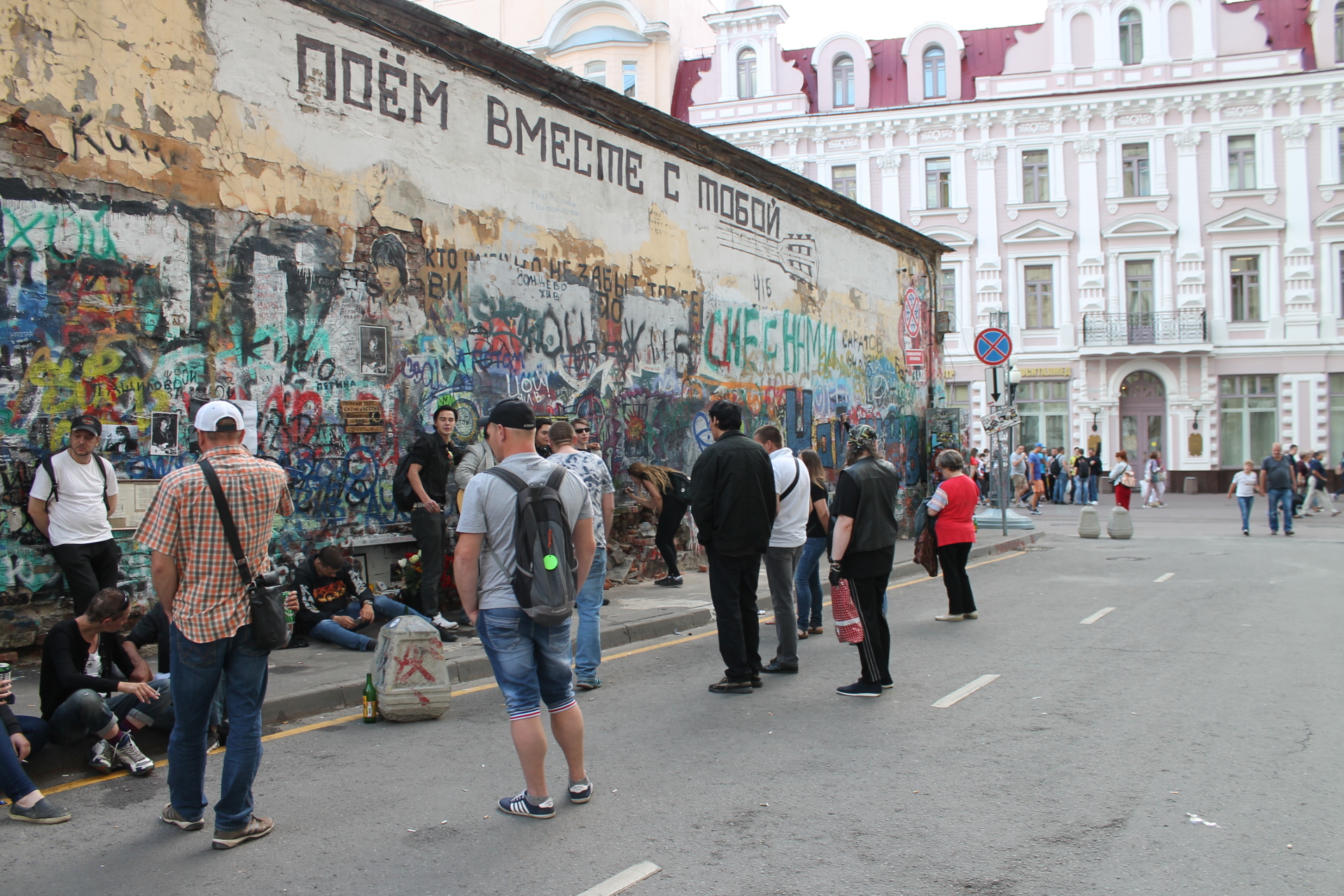
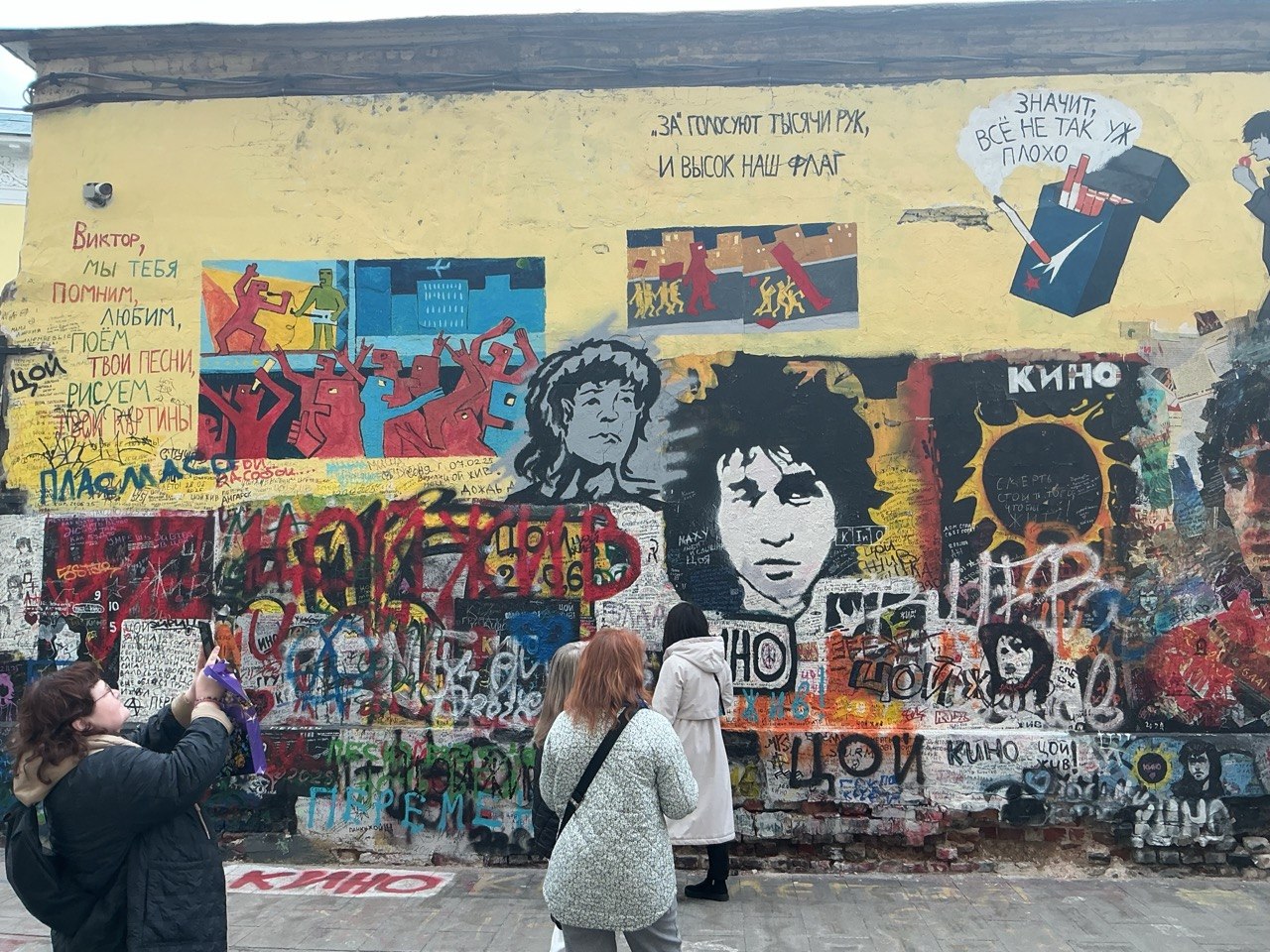
The best‑known example is the Tsoi Wall in Moscow, located near Stary Arbat (Old Arbat Street), a pedestrian street in the city’s historical center (fig. 1). Emerging immediately after Tsoi’s death, it became one of the most visible sites of Soviet rock remembrance[5]. The Wall has no direct biographical link to Tsoi, its authenticity is not archival but practical. It became ‘authentic’ or legitimate because people treated it as a site of memory. They wrote on it, left flowers, painted portraits, took photographs, sang, met friends, and returned on anniversaries. It functions not as a finished monument, but as a living surface.
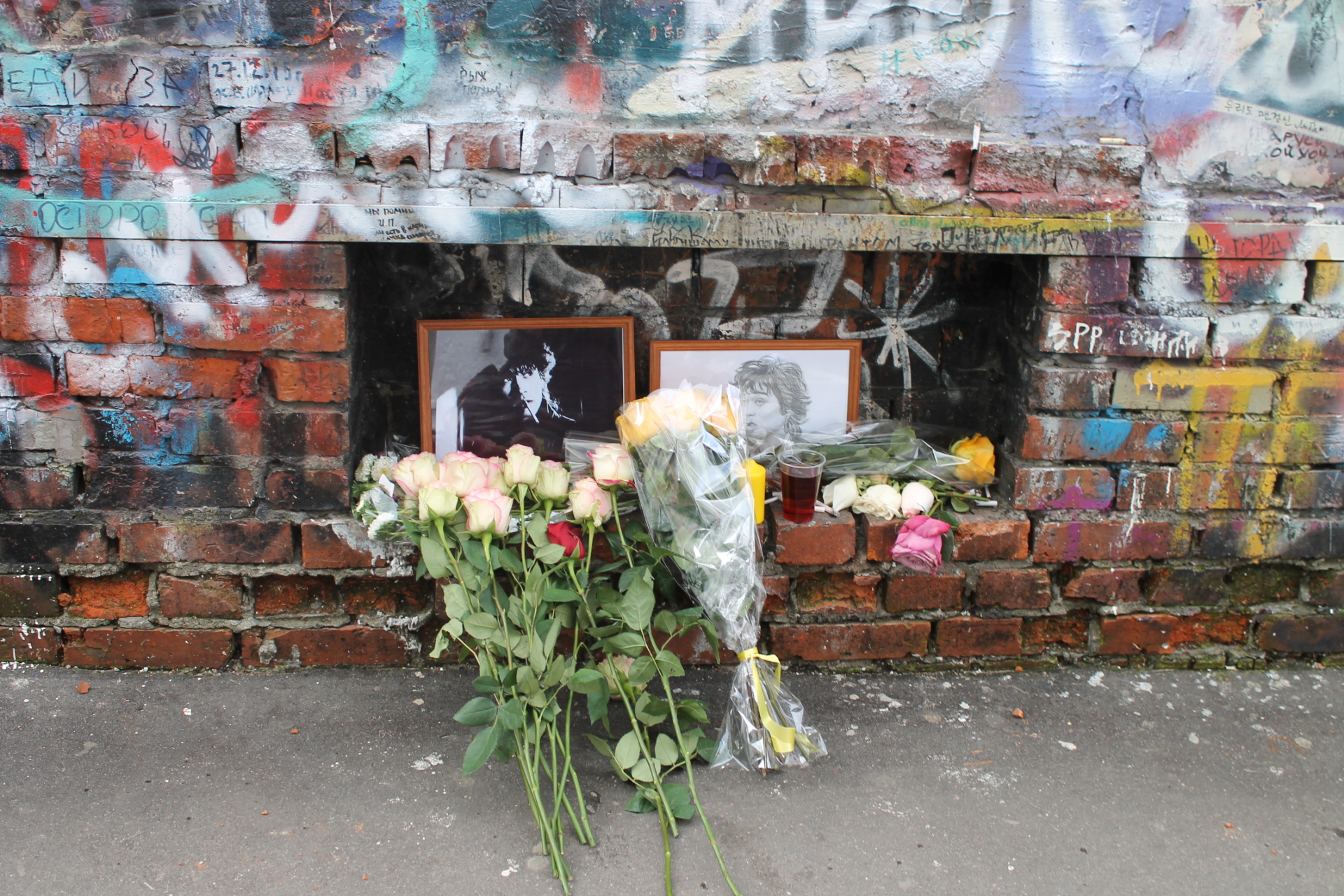
The Wall invites participation. Its material openness is crucial. It is not meant merely to be looked at; it is meant to be used (fig. 2). In this sense, it is less a monument than a memory commons: a public surface sustained by acts of contribution and care. However, this openness also makes it vulnerable. Because the Wall can be altered, it becomes a site of struggle over who gets to define Tsoi’s meaning.
This dynamic has been evident for decades. In 2006, the art group Art Destroy painted the Wall black as a provocation against Tsoi’s cult status[6]. For fans, this act constituted desecration. Yet the most significant aspect was not the intervention itself, but the response: within days, the Wall was restored and covered once again with inscriptions, including the now‑canonical phrase “Tsoi is alive.” In this case, heritage authority did not come from the police, the municipality, or an institution, but from practice.
Municipal authorities have repeatedly attempted to regulate or stabilize the site. In 2009, plans were announced to “restore” the Wall as part of the redevelopment of Stary Arbat. The project proposed preserving only fragments of the original surface and transferring the commemoration to a new memorial near Luzhniki Stadium[7]. In 2015, there was a proposal to erect a bronze monument to Tsoi near Luzhniki[8]. Fans rejected these initiatives because they perceived them not as recognition, but as appropriation: attempts to replace an open, participatory memorial with a fixed, governable form.
This is a recurring pattern in contemporary heritage politics. “Beautification” and “restoration” are not neutral acts of care; rather, they are techniques of governance. These techniques reduce unpredictability and limit who can interact and how. In response, fans engage in what might be described as low‑visibility resistance[9]: repainting, re‑inscribing, returning, and documenting. These are not dramatic acts of protest, but they are politically meaningful because they defend the conditions of participation.
From authorization to patriotic domestication
From the early 2010s onward, the political significance of the Wall intensified as Tsoi’s songs and memorial sites became more closely associated with protest cultures. The song “Peremen!” (Change!, 1989) became strongly associated with the Bolotnaya Square protests (2011–2013). The Wall itself functioned as a platform where dissent was articulated under the guise of cultural commemoration[10]. In the meantime, however, the state’s approach changed. Rather than directly confronting fan memorials, the authorities increasingly moved toward symbolic authorization. Tsoi was no longer primarily treated as an unruly late Soviet icon, but rather as a legitimate cultural figure who could be folded into a broader narrative of national greatness and continuity.
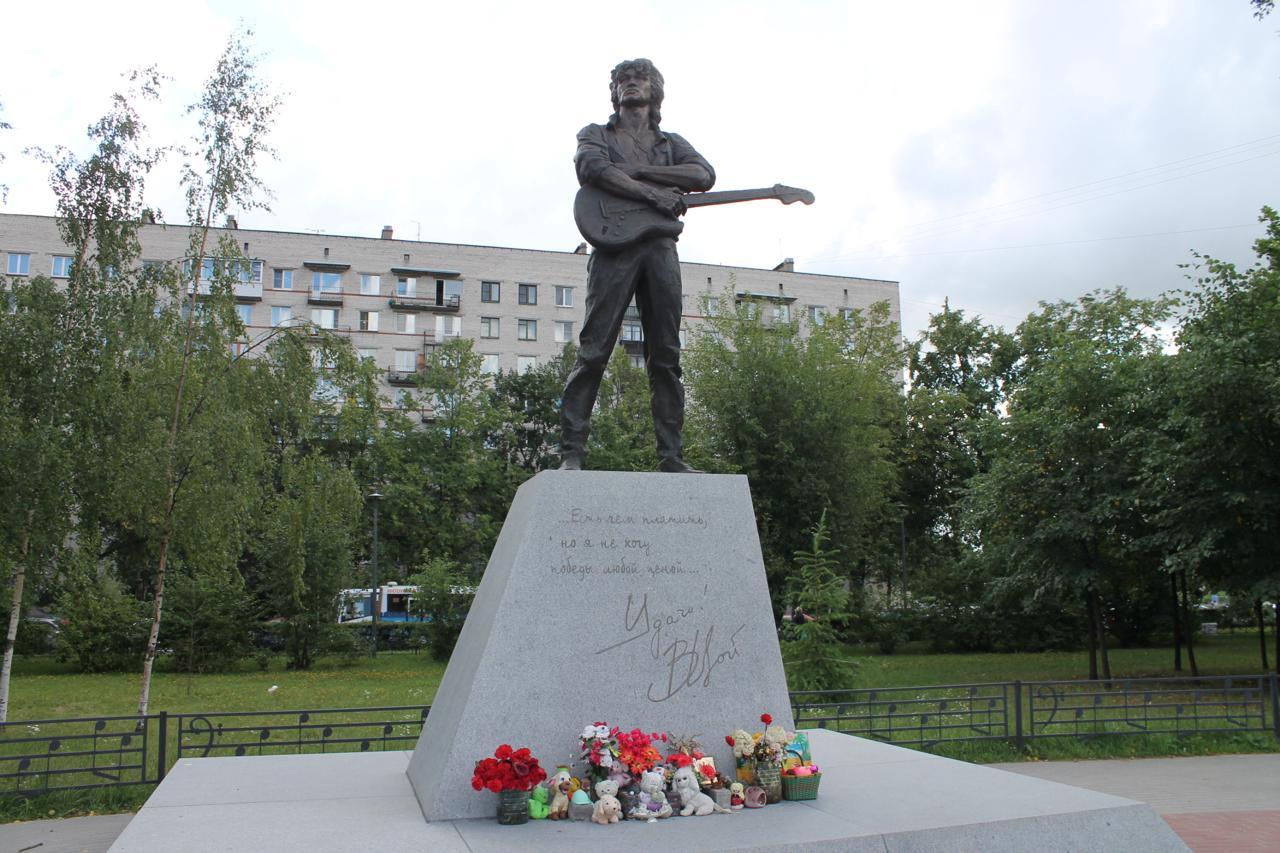
A telling example is the monument erected in Saint Petersburg in 2020 to commemorate the 30th anniversary of Tsoi’s death (fig. 3)[11]. The monument is significant not only because it exists, but because of where and how it was erected. It stands at a distance from the core fan memorial sites, recognizing Tsoi, but in a controlled manner. By doing so, it incorporates him into a legible commemorative infrastructure, while keeping him separate from the messier, more participatory landscapes of fan memory.
This is what authorization looks like in practice. It does not erase vernacular memory; it translates it into a form that institutions can manage. A monument can be visited, photographed, and respected. It cannot be rewritten. By stabilizing material form, it stabilizes meaning.
After 2022: Tsoi Goes to War
Since the beginning of Russia’s full‑scale invasion of Ukraine in February 2022, the patriotic and militarized appropriation of Soviet cultural symbols has dramatically intensified. This has affected cinema, literature, school curricula, and music alike. Foreign music—especially Ukrainian music—has faced growing restrictions, while Russian music could be banned if deemed oppositional or insufficiently patriotic[12]. At the same time, a state‑supported patriotic pop sphere, represented by artists such as Shaman, Oleg Gazmanov, and Grigori Leps started gaining increasing visibility.
Against this backdrop, Tsoi became useful again. Unlike openly oppositional artists, he was dead, canonized, and broadly popular. Unlike contemporary patriotic musicians, he carried cultural prestige, generational depth, and affective authenticity. This combination made him an ideal target for appropriation.
The key mechanism was selective recontextualization. While “Peremen!”—the song most strongly associated with political change—was never formally banned, it was increasingly replaced by other songs in public patriotic usage, most notably “Gruppa krovi” (Blood Type, 1988) and “Zvezda po imeni Solntse” (A Star Named Sun, 1989). These songs, originally marked by existential ambiguity and often read as anti‑war or anti‑militarist, were reinserted into patriotic frameworks. During rehearsals for Victory Day parades in May 2024 and May 2025, for example, soldiers sang “Gruppa krovi” on Red Square[13]. In propaganda settings, these songs began to function as part of a patriotic soundtrack.
A striking recent example appears in the documentary Mr. Nobody against Putin (2025) by Pavel Talankin and David Borenstein. In one scene, children in a provincial Russian school march to Kino’s song “Zvezda po imeni Solntse” as part of a militarized school environment shaped by wartime propaganda. The scene is powerful precisely because the song evokes an alternative memory world. This dissonance exposes the violence of patriotic recoding.
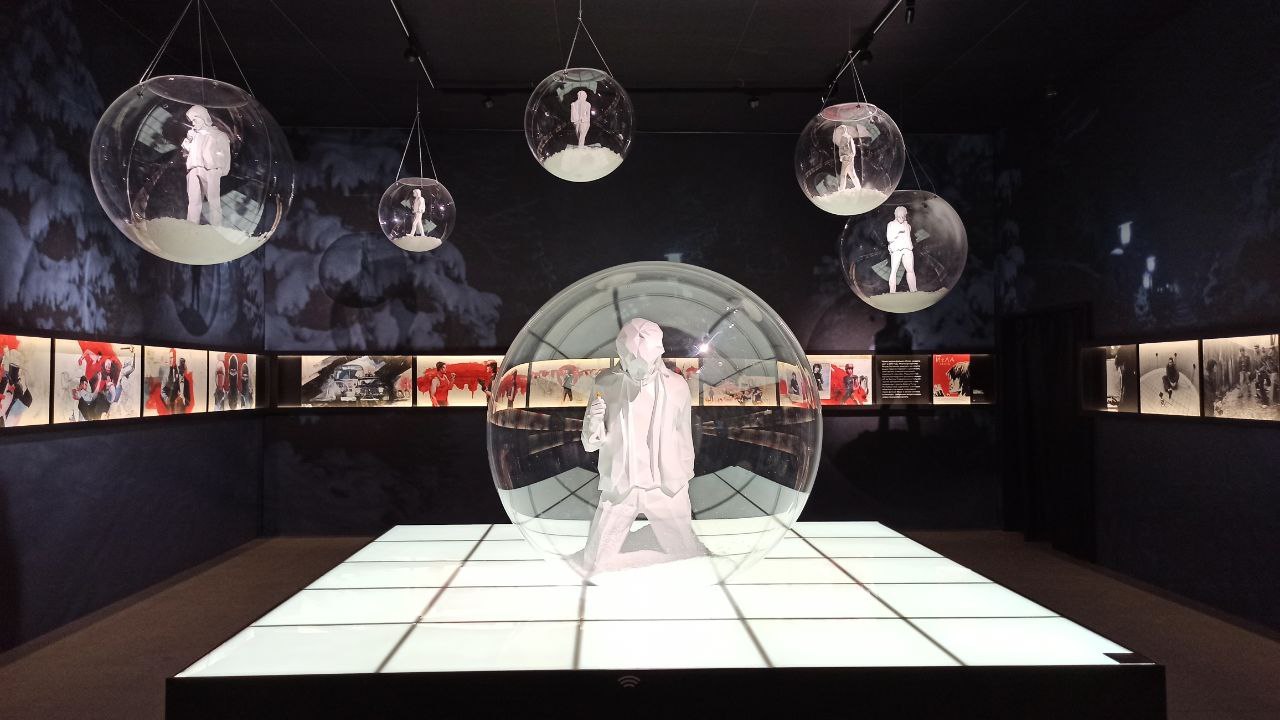
This recoding is also visual. In 2022, at the exhibition “Tsoi — put’ geroya” (Tsoi — The Hero’s Path) at the Manege in Moscow, supported by the Presidential Fund for Cultural Initiatives, Tsoi was presented as a national “cultural code” and heroic figure (fig. 4). The exhibition’s language is revealing. Tsoi is no longer portrayed merely as a musician or late Soviet icon; he becomes a heroic template, an object of myth, and a national figure whose meaning is intended to be stable and affirmative. Once this transformation has taken place, the very possibility of contestation comes to be framed as inappropriate.
Later in 2022, militarization became even more explicit when Saint Petersburg artist Aleksei Sergienko exhibited images of Tsoi in a military uniform, symbolically linking him to the so‑called “special military operation”[14]—the term Russian propaganda uses to describe its aggression against Ukraine. This was not merely patriotic domestication; it amounted to wartime recoding. Tsoi’s cultural capital was repurposed for a moral economy based on sacrifice, endurance, masculinity, and state legitimacy.
Depoliticization as a defence
How do people around Tsoi respond? The reactions are revealing. Tsoi’s son, as well as the surviving members of Kino, have largely avoided direct political commentary. Since the band’s partial reunion in 2019, they have emphasized that Tsoi’s songs were not political, often citing Tsoi’s own remarks about “Peremen!” from the late Soviet era or repeating Kino guitarist Yuri Kasparyan’s claim that the song was politicized later, especially in the 1990s[15]. Tsoi’s father, by contrast, has suggested that his son would have supported the war because he was a patriot[16].
Among fans, however, the situation is more complex. In interviews I conducted in Russia between 2013 and 2022, many fans insisted on a formulation that appears apolitical but is analytically significant: “Tsoi is not about politics—Tsoi is about brotherhood.” At first glance, this may seem like depoliticization. Yet, in the current Russian context, depoliticization can function as a protective strategy. Refusing a single political reading is to resist monopolization. Insisting that Tsoi belongs to everyone is to defend him from being fully absorbed by any one ideological project, including the state’s patriotic one.
In illiberal settings, explicit opposition is risky. Under such conditions, preserving ambiguity can itself become a form of resistance. It preserves memory’s plurality, protects spaces of affective autonomy, and allows memorials to remain sites of participation rather than sites of ideological indoctrination.
2025: the new conflict on the Wall
This dynamic became visible once again in the spring of 2025. Following the death of the extremely popular rapper Pasha Technique (Pavel Ivlev, 1984–2025), a large graffito reading “Technique” appeared beneath Tsoi’s portrait on the Tsoi Wall. The reaction was immediate. Artist Roman Yakovlev covered the inscription with posters showing Tsoi making an obscene gesture, accompanied by the slogan: “Pasha Technique is dead, Viktor Tsoi is alive”[17]. Yakovlev framed his act as a patriotic defense of Tsoi. Soon afterwards, municipal services intervened in the name of “restoration.” Earlier layers of graffiti were removed and replaced with a new official portrait of Tsoi.
Once again, the memorial was not destroyed; it was stabilized. And once again, fans responded swiftly by repainting the Wall (fig. 5). This response shows that what is at stake is not only Tsoi’s image, but the memorial’s form. Fans defend the Wall as a place where meaning remains open, and where no actor—whether an artist, city authority, patriotic activist, or institution—can permanently freeze the surface.
What is being defended?
The struggle over Viktor Tsoi in contemporary Russia is not just about a singer. It is a struggle over who has the authority to define late Soviet culture. The Russian state is increasingly seeking to transform the Soviet cultural past into an ideological resource that is patriotic, unified, emotionally resonant, and compatible with militarized narratives of national struggle. In this context, Tsoi is valuable precisely because he embodies an authenticity that contemporary patriotic culture often lacks.
However, Tsoi resists full domestication. His songs remain semantically mobile. His memorials remain materially open. His fans continue to practice a form of heritage labor that defends participation against closure. Their actions are often quiet, dispersed, and visually modest: repainting a wall, restoring an inscription, rejecting a monument, or circulating images online. Nonetheless, these acts matter politically because they preserve spaces in which memory is not yet fully governed.
This is why the militarization of Tsoi’s legacy deserves attention far beyond the field of music history. It shows how cultural heritage becomes a battleground under authoritarian and wartime conditions—not necessarily through bans, censorship, or outright destruction, but through selective appropriation, heroic reframing, and the transformation of ambiguity into patriotic certainty. But it also reveals something else: cultural resistance does not necessarily take the form of protest. Sometimes it takes the form of maintenance. Sometimes it looks like coming back with paint.
Alexandra Kolesnik is a cultural historian and postdoc researcher at Bielefeld University with a project on Rock, Memory, and Conflicts: The Heritagization of Soviet Rock Music in the Post-Soviet Space, supported by the Philipp Schwarz Initiative of the Alexander von Humboldt Foundation. In 2024/25 she spent three months at ZfL as a fellow of the DYNAMICS project.
[1] Ivan Kurilla: “History as a Political Language,” in: Sergey Rumyantsev (ed.): Education and the Politics of Memory in Russia and Eastern Europe Infested with History. London: Routledge 2025, 209–224.
[2] Vladimir Marochkin: Povsednevnaia zhizn’ rossiiskogo rok-muzykanta [The daily life of a Russian rock musician]. Moscow: Molodaia Gvardiia 2003.
[3] For a more detailed analysis cf. Alexandra Kolesnik and Alisa Maximova: “Popular Music Heritage in Ekaterinburg: From Seeking Authorisation and Nostalgia for Soviet Rock to Participatory Place-Making,” in: Stijn Reijnders et al. (eds.): Media, Place and Tourism: A World of Imagination. London/New York: Routledge 2024, 168–182; Natalija Majsova and Jasmina Šepetavc: “Popular music as living heritage: theoretical and practical challenges explored through the case of Slovenian folk pop,” in: International Journal of Heritage Studies 29.12 (2023), 1283–1298; Lizaveta Lysenka: “Soviet music heritage as a discursive middle ground in Belarusian political conflict,” in: International Journal of Heritage Studies 28.6 (2022), 752–762.
[4] Paul D. Keidl: “The Labor of Curating: Fandom, Museums, and the Value of Fan Heritage,” in: The Journal of Popular Culture 54.2 (2021), 407–431.
[5] Oksana Zaporozhets and Alexandra Kolesnik: “Music Geography in Russia: Non-Auratic Places and Institutionalization ‘in Becoming’,” in: Journal of Cultural Geography 37.1 (2020), 1–25; Oksana Zaporozhets and Alexandra Kolesnik: “Dolgaya zhizn’ mest Tsoya: geografiya pamyati” [Long life of Tsoi Places: Geography of Memory], in: Laboratorium. Russian Review of Social Research 11.2 (2019), 70–102.
[6] Sergei Nechayev: “‘Tsoy mertv’: kak oskvernyali memorial muzykanta na Arbate” [Tsoi is Dead: How the Musician’s Memorial on Arbat was Desecrated], in: Life (June 20, 2016).
[7] “Molodezhnyye dvizheniya reshili zashchitit’ stenu Tsoya” [Youth Movements Decided to Protect Tsoi Wall], in: Lenta.ru (November 13, 2009).
[8] “Pamyatnik Viktoru Tsoyu mogut ustanovit’ v ‘Luzhnikakh’” [A Monument to Viktor Tsoi May be Erected at Luzhniki Stadium], in: Moskva24 (August 18, 2015).
[9] Emmanuel Alloa: “Invisibility: From Discrimination to Resistance,” in: Critical Horizons 24.4 (2023), 325–338.
[10] Lev Gankin: “‘Khochu peremen!’: kak pesnya ‘Kino’ prevratilas’ v glavnyy politicheskiy lozung v Rossii — i pochemu Tsoy etogo voobshche-to ne khotel” [‘I Want Change!’: How Kino’s Song Became Russia’s Main Political Slogan—and Why Tsoi Didn’t Want It, Actually], in: Meduza (June 20, 2017).
[11] “V Peterburge ustanovili pamyatnik Tsou” [A Monument to Tsoi was Erected in St. Petersburg], in: Fontanka.ru (August 14, 2020).
[12] Ekaterina Ganskaya: “Back in the U.S.S.R.: Russian Popular Music in the Times of Military Censorship,” in: IASPM Journal 14.2 (2024), 30–51.
[13] Maxim Voronezhskiy: “Soldaty speli ‘Gruppu krovi’ Viktora Tsoya na Krasnoy ploshchadi” [Soldiers sang Viktor Tsoi’s ‘Blood Type’ on Red Square], in: Gazeta.ru May 9 (2025).
[14] Valentina Rodionova: “V Sankt-Peterburge prezentovali portret Viktora Tsoya s Z-nashivkoy” [A portrait of Viktor Tsoi with a Z-patch was unveiled in St. Petersburg], in: Ridus (June 22, 2022).
[15] Dmitrii Byko and Evgenii Balashov: “Yuriy Kasparyan: ‘Pesnyu ‘Peremen!’ politiziroval Boris Yel’tsin” [Yuri Kasparyan: ‘Boris Yeltsin politicized the song ‘Change!’’], in: MAXIM (October 31, 2021); “Viktor Tsoi on the song ‘Peremen’ and the film ‘ASSA’” (1988).
[16] Konstantin Bukhtatov: “Otets Tsoya rasskazal, kak muzykant otnessya by k spetsoperatsii na Ukraine” [Tsoi’s Father Spoke about How the Musician Would Feel about the Special Operation in Ukraine], in: Obshchestvennaya sluzhba novostey (May 16, 2022).
[17] Marina Sovina: “Poklonniki Pashi Tekhnika narisovali yego portret na stene Tsoya. Fanaty solista ‘Kino’ vozmutilis’ i otvetili performansom” [Pasha Tekhnik’s Fans Painted His Portrait on Tsoi Wall. Fans of the Kino Singer were Outraged and Responded with a Performance]”, in: Lenta.ru (April 13, 2025).
VORGESCHLAGENE ZITIERWEISE: Alexandra Kolesnik: Is Viktor Tsoi Alive? On the Militarization of Soviet Rock Heritage in Contemporary Russia, in: ZfL Blog, 22.6.2026, [https://www.zflprojekte.de/zfl-blog/2026/06/22/alexandra-kolesnik-is-viktor-tsoi-alive-on-the-militarization-of-soviet-rock-heritage-in-contemporary-russia].
DOI: https://doi.org/10.13151/zfl-blog/20260622-01